Anička and the Terribly Impossible Task
Anička had started school.
The first days she rather liked.
She had her own desk. A pencil case. Coloured pencils. A schoolbag almost as big as she was. And above all — break time.
Breaks, according to Anička, were an excellent school invention.
You didn’t have to count anything, trace anything, or figure out whether a little letter was hiding on the left or on the right.
But then one morning came.
The teacher handed out a worksheet.
“Right,” she said cheerfully. “Now we’ll do this task.”
Anička looked at the paper.
There were about six lines on it.
Maybe seven.
Maybe a hundred and forty-eight.
Because right then it seemed to Anička that the paper stretched all the way into the next classroom.
“No,” she said.
The teacher paused.
“No what?”
“I’m not going to do it.”
“Try the first line.”
“No.”
“I’ll help you.”
“NO!”
And then something happened that Anička hadn’t planned at all.
Her eyes filled with tears.
One tear fell on the desk.
The second on the paper.
And the third slid straight down Anička’s nose.
“Wonderful,” Anička muttered. “Now I’ve got a wet worksheet too.”
The teacher sat down beside her.
“Anička, what’s going on?”
But Anička didn’t know.
She only knew that she didn’t want that task.
That she really, really didn’t want it.
So much that if the worksheet had grown little legs and run out of the classroom, she wouldn’t have chased it at all.
That afternoon at home Anička sat at the table and told Mum about it.
“I just didn’t want to do it.”
“And was it hard?” Mum asked.
Anička shrugged.
“I don’t know.”
“Were you afraid you’d do it wrong?”
Anička shrugged again.
“Maybe.”
“Were you tired?”
“Maybe.”
“Or were you annoyed that someone told you what to do?”
Anička thought about it.
“Maybe that too.”
Mum laughed.
“Looks like you’ve got quite a meeting going on in your head.”
“What meeting?”
“Why, a meeting of your little head-sprites.”
Anička looked at her suspiciously.
“I’ve got sprites in my head?”
“At least three.”
Mum started counting on her fingers.
“The first is a sprite called Don’twannamir.”
“He says: I WON’T DO ANYTHING.”
Anička burst out laughing.
“Yeah. I know that one.”
“Then there’s Scarella.”
“She whispers: What if you can’t do it? What if you make a mistake? What if the others already know what to do, and you don’t?”
Anička stopped laughing.
“And one more,” Mum went on. “His name is Tiredin.”
“He hardly says anything. He just lies down on the sofa in your head and announces: Not today. Closed.”
Anička started laughing again.
“And who is in charge of them?”
Mum looked at her.
“You.”
“Me?”
“Of course.”
“But sometimes they’re terribly loud.”
“That’s true. Especially Don’twannamir. I think he’s got a megaphone.”
The next day at school the children got another task.
Anička looked at it.
And there it was again.
A knot formed in her tummy.
Someone in her head roared:
I DON’T WANT TO!
Tears began to press into Anička’s eyes.
The teacher noticed.
But this time Anička raised her hand.
“Miss?”
“Yes?”
“I think Don’twannamir has started shouting in my head.”
The teacher was quiet for a moment.
“Pardon?”
Anička explained the sprites in her head.
The teacher smiled.
“Ah. So what shall we do with him?”
Anička looked at the whole worksheet.
“I don’t want to do all of it.”
“Then don’t do all of it.”
Anička’s eyes went wide.
“What?”
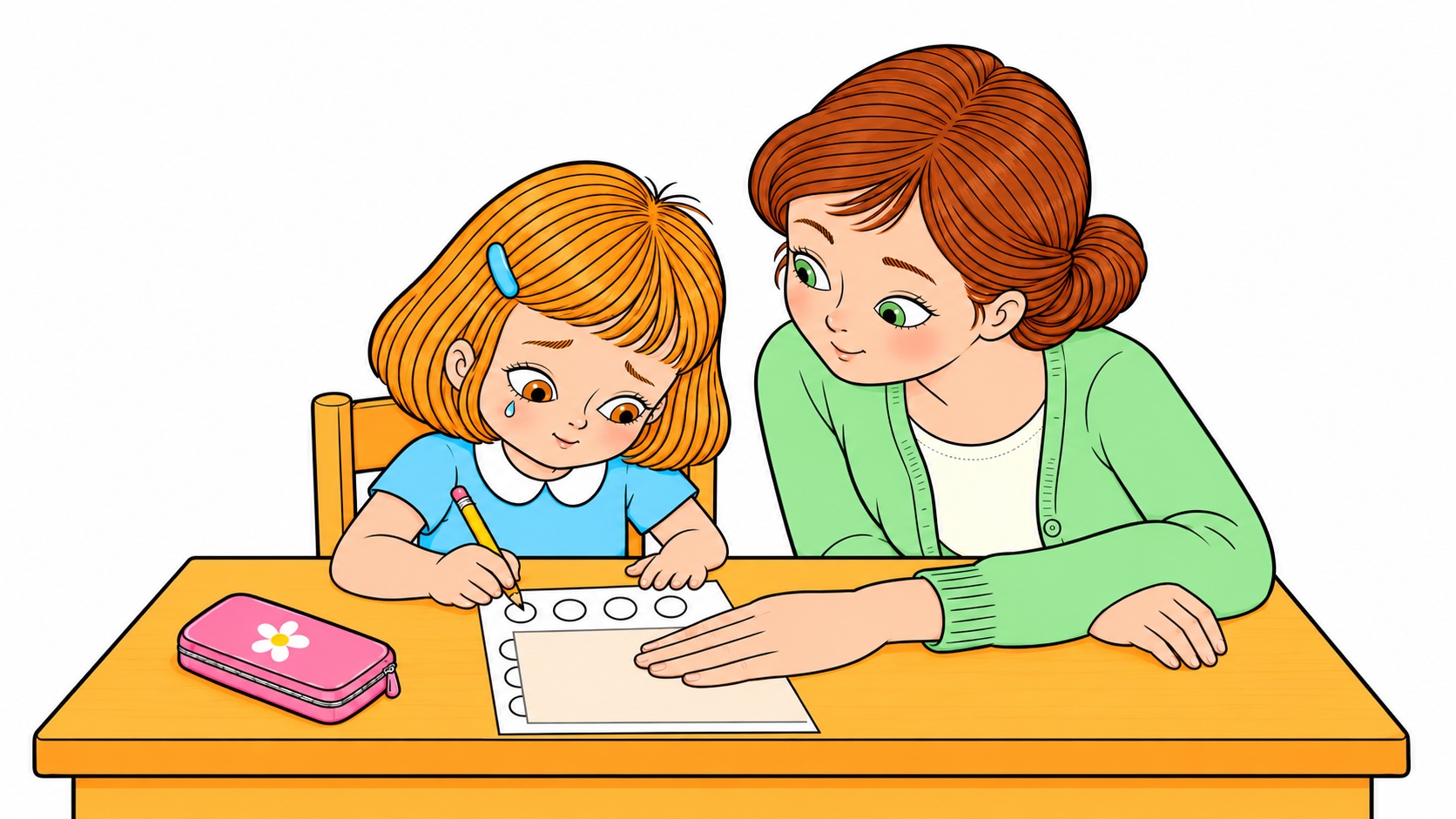
The teacher covered almost the whole paper with her hand.
She left only the first tiny task visible.
“Just do this one.”
Anička did it.
“And now?”
The teacher uncovered the second.
Anička did that one too.
On the third she made a mistake.
“See!” she blurted. “I can’t do it!”
The teacher looked at the mistake.
“Wonderful.”
“How wonderful? It’s wrong.”
“Yes. And we’ve just found out what you still need to understand.”
Anička thought for a moment.
That was strange.
In preschool a mistake was usually just something you fixed.
But at school it seemed to Anička that a mistake meant:
WATCH OUT! EVERYONE HAS FOUND OUT YOU CAN’T DO ANYTHING!
But the teacher didn’t look at all as if something terrible had happened.
She only said:
“Let’s try it together.”
And they did.
Then Anička finished two more tasks.
The last one wouldn’t come.
She felt Don’twannamir taking another breath.
“I DON’—”
But Anička stopped him in her mind.
“Wait.”
Then she said to the teacher:
“I don’t know how to start right now.”
And the teacher showed her the first step.
Suddenly it dawned on Anička.
Maybe there was a big difference between the sentences:
“I WON’T DO IT!”
and
“I DON’T KNOW HOW TO START.”
Also between:
“THIS IS AWFUL!”
and
“CAN YOU HELP ME?”
And even between:
“I CAN’T DO IT!”
and
“I CAN’T DO IT YET.”
Of course, from then on Anička did not suddenly do every task with enthusiasm.
Not at all.
Some tasks still seemed boring.
Over some she sighed so loudly that, in her opinion, people outside might expect a storm was coming.
Once she even looked at a page in the textbook and said:
“Who invented this? I’d like a word with them.”
But gradually she discovered something important.
When tears, anger, or a big I DON’T WANT TO arrived, it didn’t always mean:
“I’m not going to do this task.”
Sometimes it meant:
It’s too much for me.
I don’t know what to do.
I’m afraid I’ll get it wrong.
I need a little help.
I need to start with just one small piece.
And sometimes, of course, also:
This really is a drag.
But even a drag could be done.
Piece by piece.
One day Anička got a worksheet with truly lots of tasks.
She looked at it.
She took a breath.
A faint voice rose in her head:
“Don’t wannaaa…”
Anička picked up her pencil.
“I hear you, Don’twannamir.”
She did the first task.
“But today you’re not the one deciding.”
And from her head came an offended:
“Fine, then I’ll at least go lie down next to Tiredin.”
And Anička had to laugh.
Because school wasn’t a place where you had to know everything already.
It was a place you went to learn the things you didn’t know yet.
And if you already knew everything beforehand?
Then you wouldn’t really need to go at all.
The end.